“Both Betty and Shirley were excellent dancers, almost
professionally spry, unlike Edith, who had two left feet. (‘Even possible three,’ Betty said.) They had talked about setting up a dance
academy within one of the clubs, where members would pay extra to learn the
latest dances or polish up the old ones. Nellie was ruminating on the
idea. They doubted she would ever digest
it.”
Wednesday, July 17, 2024
SHRINES OF GAIETY by Kate Atkinson
Two teenagers, Freda and Florence, have run away from home
in the last 1920s to seek fame and fortune as dancers in London. Freda has some talent, but Florence—not so
much. After pocketing an unexpected
inheritance, Gwendolen Kelling dashes off from her Yorkshire home and her job
as a librarian to search for the girls, at the behest of Freda’s
half-sister. Gwendolen and a policeman
named Frobisher find that they can help one another out if Gwendolen will do
some undercover snooping at the Amethyst, a bar owned by the notorious Nellie
Coker, who has recently been released from prison. Gwendolen proves herself to be calm and
capable in an emergency and finds herself managing Nellie’s swankiest watering
hole. Gwendolen may be the heroine of
this novel, but Nellie’s six children—2 men and 4 women—are the colorful
characters here, particularly the men. I
would say that all six are adults, but several of them don’t really fit that
category in terms of their behavior.
London does not come off very well, either, as the police force is
mostly corrupt if not downright dangerous to those it is supposed to protect,
and the city is rife with pickpockets and purse snatchers. The author handles all of the characters,
plots and subplots with her usual deftness, and her way with words always
delights. One of my favorite passages is
on page 147, in a paragraph regarding three of Nellie’s daughters:
Wednesday, July 10, 2024
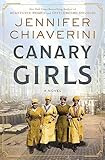
CANARY GIRLS by Jennifer Chiaverini
Helen’s husband, Arthur Purcell, is managing one of his
industrialist family’s manufacturing plants, which has been converted from a
sewing machine factory to a munitions arsenal.
World War I has just broken out, and Lucy’s husband, Daniel, an
architect and star footballer (soccer player) has joined a British infantry
regiment. April is a former domestic
servant who goes to work in the Purcell factory’s Danger Building, loading
fuses with TNT. Lucy obtains a more
skilled position at the same factory, and they become teammates on the
company’s women’s football team. Helen,
who becomes a liaison between management and the many women working in her
husband’s factory, soon discovers that handling TNT is a health hazard for the
workers and gives their skin a yellow tint.
Hence, the moniker “canary girls.”
Respiratory issues are an even bigger problem, and Helen does what she
can to improve the safety of the workers.
At the top of the hazards list, however, is the risk of an explosion,
and no metal objects or incendiary materials are allowed in the building. This novel follows the lives of these three
women in particular but the plight of the canary girls in general. They bond on the football pitch and share in
their concerns for one another’s health and welfare, but they continue to work
under these conditions because the money is better than anything they can find
anywhere else. Also, they seem to have a
genuine desire to contribute to the war effort and an appreciation for the
essential nature of their jobs. I did
not revel in the prose here, but the novel moves at a pretty brisk pace and
gave me an in-depth look at the circumstances that kept the canary girls
working in an unsafe and unhealthy setting.
Wednesday, July 3, 2024
THE FRAUD by Zadie Smith
Who exactly is the title character in this novel? There are several candidates, all real
historical figures and all men. Eliza
Touchet, however, is the central character here, a widow who resides in the
home of her cousin, William Ainsworth, for decades. Ainsworth is a novelist whose work becomes
increasingly ponderous and less popular as the years go by, and as his friend
Charles Dickens surpasses him as a celebrated author. At one point, Smith intimates that Ainsworth
may not have been the originator of his early books’ plots, and it is perhaps
for this reason that Ainsworth becomes a writer of historical fiction and loses
his literary audience. During this
period in England in the 1800s a trial takes place that commands Mrs. Touchet’s
attention, as well as that of Ainsworth’s second wife, a former maid named
Sarah. The trial involves a “Claimant’s”
insistence that he is Sir Roger Tichborne and that he survived a shipwreck in
which all other occupants died. All
evidence indicates that the Claimant is an opportunistic fraud, but a former
slave named Andrew Bogle corroborates the Claimant’s unlikely story. While Sarah joins the ranks of the Claimant’s
supporters, Mrs. Touchet seeks out Bogle and elicits his personal history. The writing here is excellent but does not
quite compensate for the dreary, staid storyline and lack of suspense. Plus, the timeline meanders and isn’t always
obvious. Mrs. Touchet is an intriguing
character, in that she adores Ainsworth, feeding his ego with compliments even
as her inner voice derides his abysmal later manuscripts.
Wednesday, June 26, 2024
WINTER WORK by Dan Fesperman
The Berlin wall has just come down, and former East German
intelligence officials are either destroying documents or trying to sell them
to the CIA. This novel opens with the
death of one such Stasi officer who was apparently in the “sell” camp and
possibly murdered by a competitor. Emil
Grimm, who was friends with the dead officer, now seeks to make his own deal
with the Americans. His wife is dying of
ALS and is playing matchmaker to Emil and her caretaker, Karola. Emil just wants money and passports to get
all three of them out of Germany.
Claire, his CIA contact, begins to sympathize with Emil and his
desperation and puts her own life at risk to cut a deal with him. The Russian KGB operatives, stereotypically
burly and violent, serve as the main villains here. This novel is basically an imagined story
behind the acquisition of the Rosenholz files, which gave the U.S. a trove of
information regarding alleged East German spies. The writing in this book is perfunctory, but
the pacing is decent, and the historical context is fascinating. I have not read much, if anything, about the
immediate aftereffects of Cold War and the reunification of Germany. Certainly I never considered how so many
people lost their jobs, and I don’t mean just the Stasi employees. Granted, they were engaged in efforts to
infiltrate and undermine U.S. and European government entities, but their
custodial staff, for example, were not.
I think it’s a bit risky for the author to paint Emil as someone deserving
of a bailout, but it works.
Wednesday, June 19, 2024
BOOK LOVERS by Emily Henry
Nora is a literary agent who agrees to accompany her younger sister, Libby, to Sunshine Falls, NC, for a month in August. The town is the setting for a best-selling novel that one of Nora’s most successful clients has written. Libby tries to break down Nora’s all-work-and-no-play image by creating a checklist of things to accomplish in Sunshine Falls—go skinny-dipping, ride a horse, sleep under the stars, and save a floundering local business, among other things. One item is specifically for Nora—go on dates with two locals. Libby herself is married with two young daughters but appears to be struggling with a personal issue that she refuses to share with Nora, who has tried to be both mother and father to Libby for most of their lives. Charlie Lastra, the executive editor at a NY publishing house, passed on the Sunshine Falls novel, but Nora (literally) runs into him in a bar there. Too convenient? Too coincidental? Who cares? On the one hand I think of this novel as a guilty pleasure, but it has some of the best verbal sparring I have ever read. Yes, it’s a rom-com, but I was hooked by the sparkling repartee as much as by the smoldering love story. I must be a romantic at heart, because this is one of those books that I just cannot get out of my head.
Wednesday, June 12, 2024
SEA OF TRANQUILITY by Emily St. John Mandel
I loved Mandel’s Station
Eleven and The
Glass Hotel, but this novel was a disappointment for me. I also generally love time travel novels,
including Stephen King’s 11/22/63
and Scott Alexander Howard’s The
Other Valley. In this
book, however, I was never invested in the characters, and the plot was just
too complicated. If ever there was a
novel that demanded a reread, this is it.
About halfway through the novel I realized that Gaspery, born in the
2400s, is the main character. He grew up in a domed colony, nicknamed Night
City because the lights were too expensive to repair, on the moon. His sister Zoey works for the mysterious Time
Institute on Earth, and Gaspery secures a position as a time traveler for the
Institute. Zoey warns him that the job
is dangerous, since the Institute will not tolerate interference in the
past. The characters whom he visits in
the past are introduced in the first half of the book, and by the time
Gaspery’s visits take place, I had forgotten the details of these characters’
lives. The author does not address how
Earth survives global warming nor how life is different on Earth four centuries
from now. In fact, everything is about
the same, except for colonization and travel to and from our moon, as well as
Saturn’s moon, Titan. Of course, the
time travel is futuristic, if you believe that we will be able to do that
someday, but Mandel really has something else in mind with the time travel, and
I didn’t buy that at all. My favorite
incident in the novel is when Gaspery learns that his cat is an unwitting time
traveler who came from 1985. Gaspery is
stunned by that revelation, but as Zoey says, “Honestly, Gaspery, what
difference would it make. A cat’s a
cat.” Priceless.
Wednesday, June 5, 2024
PINEAPPLE STREET by Jenny Jackson
This novel about a filthy rich family focuses on three very smart women. Darley gave up her trust fund so that she could marry Malcolm without a pre-nup and gave up her career as well. Georgiana, Darley’s younger sister, works for a non-profit and becomes romantically involved with Brady, who works at the same company. Sasha is married to Cord, Darley and Georgiana’s brother, and lives in the family home, which is still littered with childhood keepsakes and deteriorating furniture that Cord’s family will not allow Sasha to get rid of. Plus, Sasha’s sisters-in-law privately refer to her as GD—Gold Digger—and erroneously believe that she did not sign a pre-nup. All the talk of lost jewelry, deb balls, lunches at the club, and private schools was just too much privilege for me. Don’t get me wrong; these are not bad people, but their problems, by and large, are not problems that I can really relate to. And, as in many of these family dramas, there are secrets galore. Georgiana has a secret that is basically tearing her apart, and she shares it with Sasha, in confidence, of course. Then when the secret finally is revealed, everyone is mad at Sasha for not telling everyone sooner. But, wait. Isn’t that what someone is supposed to do with a secret? Keep it a secret, right? Darley and Malcom also have a secret, until they finally realize that the longer they hold on to the secret, the worse the humiliation is going to be. At times I just wanted to throw up my hands and tell these people to get over themselves.
Subscribe to:
Posts (Atom)